The Repair & Coating System
Structural repair, surface profile, basecoat, topcoat — in that order, for a reason.
Request Technical Data SheetsStep 1 — Concrete Mender: Structural Repair
Concrete Mender is a penetrating structural repair resin. Its usefulness comes from viscosity: it is thin enough to travel into the crack network, the microfractures around a spall, and the open porosity of degraded concrete, rather than bridging over the top of them.
That penetration is what makes the repair structural rather than cosmetic. The resin cures inside the concrete matrix and re-establishes load transfer across the defect. A joint that was spalling because the edges could no longer carry wheel load can carry it again.
Where it is used: spalled and raveling control joints, cracks from settlement and shrinkage, popouts, surface delamination, dock edges, ramp noses, and corners that have taken impact.
Sequence: clean and open the defect down to sound concrete, remove dust and contamination, apply Concrete Mender, allow it to cure, then grind flush. The repaired area is then profiled and coated identically to the rest of the slab.
Not a substitute for: structural repair of failed subgrade, rebar corrosion requiring exposure and treatment, or slabs that have lost bearing. We will tell you if the job is past what a resin repair can fix.
Step 2 — Preparation: The Part People Skip
Mechanical profile to CSP 3–5. Diamond grinding or shot blasting, depending on the slab and the size. This is not negotiable and it is not achievable with acid etching. A coating bonds to profile; a smooth troweled surface gives it nothing to hold.
Verify moisture vapor emission. Slabs on grade without a functioning vapor barrier push moisture upward continuously. Coat over that and hydrostatic pressure will lift the coating in sheets six months later, and it will not be the coating's fault. Test it before you quote it.
Degrease before you grind. On shop, plant, and truck bay floors, oil has usually penetrated deep. Grinding an oil-saturated slab just exposes fresh oil-contaminated concrete. Super Orange Cleaner first, then mechanical prep.
Prime where it earns its keep. 7001 Primer stops bleed-through from stains and residual finishes, and carries the system onto adjacent metal, wood, and membrane details — trench drain frames, dock plates, curb transitions.
Step 3 — Basecoat and Topcoat
OR-621 basecoat is the bond and build layer. It goes over the profiled, tested slab and establishes the mechanical and chemical grip the rest of the system relies on.
OR-55 topcoat is the finish and wear layer — chemically resistant, UV-stable, available clear or pigmented. Where a decorative or non-slip surface is specified, flake or quartz is broadcast between the basecoat and topcoat and locked in by the finish.
OR-75DCL topcoat, OR-ACR-42, and OR-E41 epoxy primer are available where a job calls for a different build, gloss, or tie-coat chemistry.
Because these are fast-cure systems, the practical schedule on a typical job is repair and grind in the morning, prep and basecoat by midday, topcoat in the afternoon, foot traffic the next morning. Compare that with the week a repour costs you.
System Specification Summary
| Property | Value |
|---|---|
| Repair product | Concrete Mender — penetrating structural resin |
| Required substrate profile | CSP 3–5, mechanically achieved |
| Prep methods | Diamond grinding or shot blasting |
| Moisture check | Moisture vapor emission test before coating |
| Degreasing | Super Orange Cleaner on oil-contaminated slabs |
| Primer | 7001 Primer — multi-surface, stops bleed-through |
| Basecoat | OR-621 |
| Topcoat | OR-55 (alt: OR-75DCL) |
| Epoxy tie-coat option | OR-E41 |
| Decorative option | Flake or quartz broadcast between coats |
| Coverage basis | 1,604 mil-sq-ft per gallon at 100% solids |
| Typical return to service | Foot traffic next day, vehicle traffic shortly after |
| Service temperature | −40°F to 250°F for polyurea components |
Exterior and Below-Grade Concrete
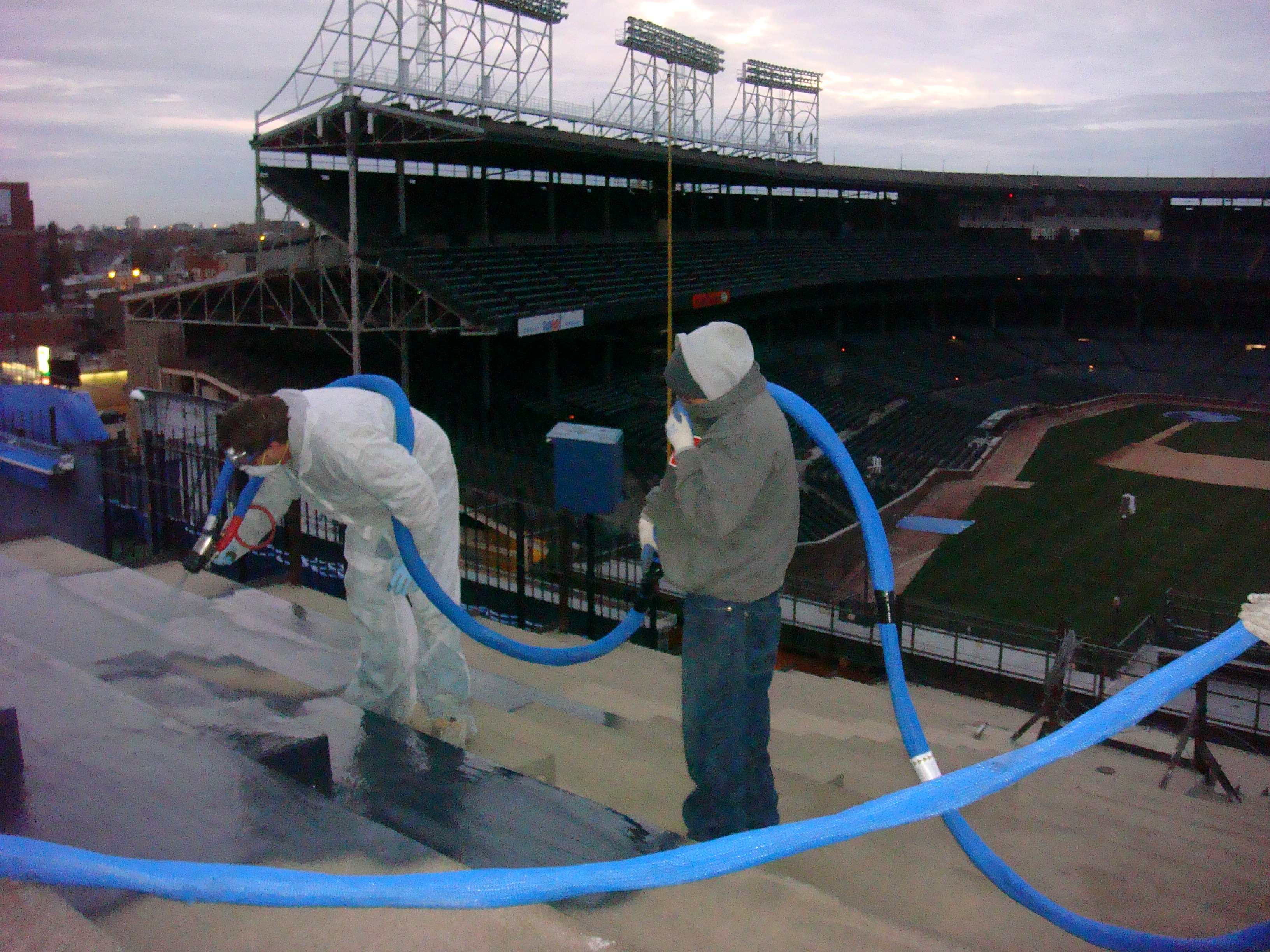
The system is not limited to interior floors. Exterior concrete — loading docks, ramps, aprons, steps, curbs, parking decks — takes the same repair sequence, with freeze-thaw cycling as the added failure driver rather than forklift traffic.
For below-grade concrete, Badger Black is the 100%-solids polyurea specified for foundation walls and retaining structures. Applied at 40–60 mil DFT over primed, cured concrete and carried up to the grade line, it is a seamless waterproofing membrane on a surface nobody will ever be able to inspect again.
For containment structures, trench drains, and water-contact concrete, OR7K at 60–80 mil DFT gives a monolithic lining with no joints for product to find.
Need the Full Technical Package?
Technical data sheets, safety data sheets, and the application guide for Concrete Mender and the coating system.
Request DocumentationGet Concrete Repair Pricing
Tell us about your project and we will follow up with product details, technical data sheets, and pricing.